


Fender Hotrod Amps
For pro’s and hobbyists alike, the Fender Hotrod amps are often described as "venerable workhorses", for a variety of genres. They are frequently pro backline / PA company's "go-to" hire amp.
They’re fairly portable and loud as hell.
The clean is ultra-clean, so they make a great pedal platform. Because the cabinet size allows for a full length tank, the reverb is rich, and the overdrive and distortion is considered useable (ok, that's controversial).
When it comes time for repairs and servicing though, Hotrods can be quite demanding. Worthwhile, for sure, but here’s a brief synopsis of what can / should be undertaken, along with some tone mods which have proved very popular with customers wanting a more traditional Fender tone.

Filter Capacitors

The large blue and grey cylindrical components are the "electrolytic" filter capacitors, which filter out the AC "ripple" from the DC supply which provides the power to the plates of your valves. These ones are notorious for failing before their time, and when they do, they can cause multiple problems, such as increased mains hum from the speaker, reduced power, and even oscillation (squeals, overtones etc.)
At Surrey Audio Works, we prefer to replace these with very high quality German F&T brand capacitors.
To do it properly is a "board-out" job, so other electrolytic capacitors are replaced at the same time, including those for the bias supply, which are crucial, and the low voltage supply, which I'll come to......
Low Voltage Supply
Pictured are the two 5 Watt ceramic resistors, two 3 Watt Zenner diodes and two capacitors associated with the power supply which feeds the circuits controlling the channel switching and the reverb. The manufacturer has mounted the resistors and diodes close to the PCB, which causes the pads and traces beneath to overheat and eventually fail. The capacitors fail early too, because they are mounted so close to the heat-emitting components. The first symptom guitarists will be aware of, is probably when their reverb and channel switching stops working in the middle of a gig, by which time, a lot of damage has been done to the back of the PCB. It's a daft design, from everyone's viewpoint, with the possible exception of the accountants.

The Repair
The pads and traces are repaired or modified to provide adequate support for the new components. High quality up-rated components are fitted and their legs are shaped with a special tool, to increase rigidity and support, and space them from the board to allow airflow, so the issue is effectively resolved. New high quality capacitors are fitted and supported with new adhesive.


The footswitch supply dropper resistor is replaced in the same way, for the same reason - you can see the discolouration beneath the board, where the original resistor had been cooking it, and below, what the overheating does to the pads.


Ribbon Cables
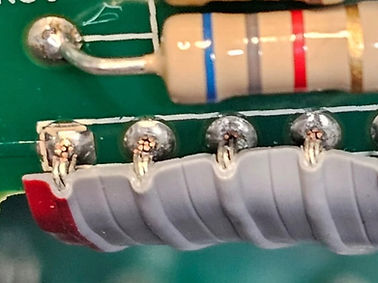
Any electrician who has studied the wiring regulations can tell you about minimum radius bends for wires - there's a table of values you are expected to adhere to. When you bend a multi-stranded cable, the strands on the outside of the bend will stretch - they have to.
Copper is a soft metal, so it will stretch a fair bit. Add years of vibration to the recipe, and eventually, you'll get fractures. Nobody seems to have told Fender, (or Peavey for that matter).
If they're still in good condition, then often there's enough slack to adjust them so there's less stress, otherwise the cable might need re-terminating or replacing.
Speaker Jack Plug
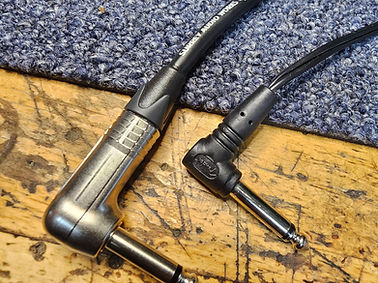
The stock moulded jack plug is a show-spoiler waiting to happen. These cheapy connectors have a rivetted tip connection (which you can't see because it's moulded) which vibrates loose and eventually fails altogether. We replace them with a genuine Neutrik angled plug, The bit you solder to is the same piece of metal which forms the tip of the connector, so there's nothing to vibrate loose.
Tone Modifications

On the Hotrod amps for some reason, Fender chose some quite "un-Fenderish" component values in some parts of the circuit which are critical to the tone "signature" of the amplifier. Some of these deviations from standard Fender practice, align closely with many of the gripes that owners often have about the shortcomings of the sound of the amp. Surrey Audio Works have compiled a short list of some of the most popular modifications, which bring the tone circuit back to a more traditional Fender spec. They're not expensive to achieve whilst the PCB is out of the chassis, so why not give the amp it's best chance. We always have excellent feedback from customers about their upgraded amps, which is very rewarding to hear.
Is It Worth It? Well, Yes It Is!
I know what you're thinking - and yes, this is a lot of work, but it can transform the amp into a super-dependable, trustworthy tool of your trade. Please don't compare the cost of repairs to second hand Hotrod prices - all those Hotrods on ebay and Facebook Marketplace, will need most or all of these jobs doing. Actually, buying an older Hotrod, second-hand, and having it refurbished by Surrey Audio Works, is a cost-effective way to buy one, which will be a considerably superior machine compared to a brand new one! Spend the money you save on a posh speaker for it. 😃
Surrey Audio works have completed dozens of Hotrod amps for all kinds of players, who have been delighted with the work - just check some of our Google reviews!
So don't leave your faulty or unreliable Hotrod amp in the cupboard - get it to Surrey Audio Works for a service / refurbishment / revitalisation - we bet you won't regret it!