


Fender Deluxe Reverb Reisue
When it comes time for repairs and servicing, the Deluxe Reverb Reissue presents its own set of quirks. It’s very much a modern production amp, with all the compromises that implies. What follows is a brief overview of the common maintenance work, reliability updates, and a few well-chosen tweaks for those chasing a more authentic vintage amp-like response.
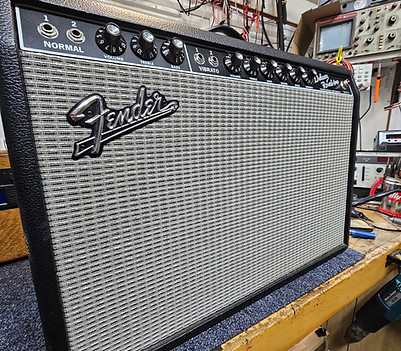
For pro’s and hobbyists alike, the Deluxe Reverb Reissue has an impressive reputation. It provides some classic Fender tones in a fairly compact form, at a volume that will be adequate for the vast majority of guitarists, without breaking either the bank, or their back. It’s a regular choice on stages, in studios, and in the backlines of hire companies who need something dependable that flatters just about any guitar you plug into it. The sound is bright, open, and dynamic in that unmistakable Fender way. Add to that the long-spring reverb and built-in vibrato, and you’ve got the classic sound that countless recordings were built on.

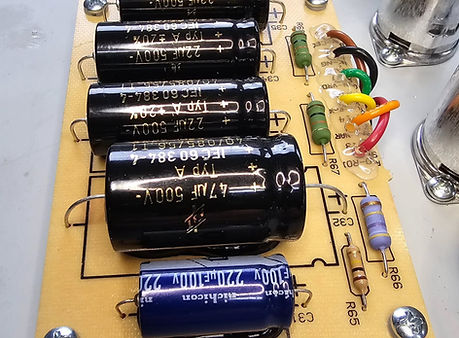
Filter Capacitors
The black and grey cylindrical components are the "electrolytic" filter capacitors, which filter out the AC "ripple" from the DC supply which provides the power to the plates of your valves. These ones are notorious for failing before their time, and when they do, they can cause multiple problems, such as increased mains hum from the speaker, reduced power, and even oscillation (squeals, overtones etc.)
At Surrey Audio Works, we prefer to replace these with very high quality German F&T and Japanese Nichicon brand capacitors.
On a Deluxe Reverb, they're underneath the chassis on a separate board in a "doghouse". On the main board are the capacitors for the bias supply, which should also be replaced, as their role is so crucial.
The Hiss Issue
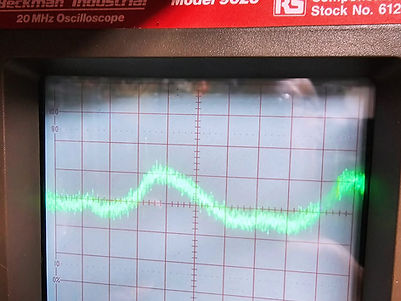
There are multiple reasons why these reissue amps are not as quiet as their vintage ancestors, and are honestly one of the noisiest amplifiers on the market, brand new, straight off the shelf. The photo of the scope trace opposite shows about 20mV of mains hum on the output (which isn't too bad) but about 5mV of hiss sitting on top, which is a lot. It sounds many times worse when the vibrato is used, as it's so much more obvious.
The good news is that many of the root causes can be tackled, and the noise floor brought down to an acceptable level.
Lets have a little list, in no particular order;
1) "lead-dress", which is how the leads between the pcb and valve sockets are physically arranged and interract
2) Sensitive, high impedance, un-screened signal paths through long sections of the PCB, picking up interferrance
3) Agricultural channel linking (on the '68) adding noise to noise so it's twice as noisy!
4) Vibrato Opto-coupler emulation (worth mentioning separately)
5) Bright Cap Mod.
6) Gain structure.
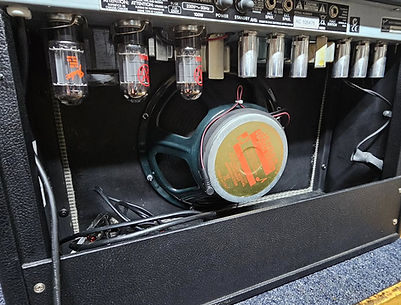
Minimising Interferrance
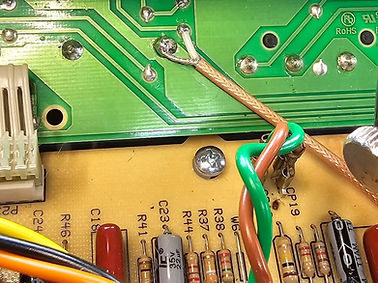
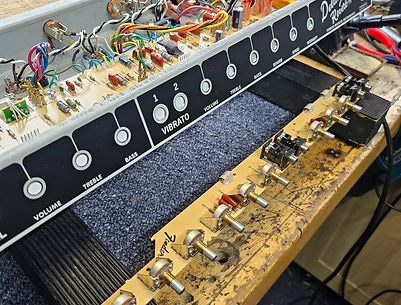
Just running wires from the pcb to the valve sockets "any old way" can be problematic. Wires carrying particular noise (such as the vibrato oscillator) right next to high impedance grid wires, can induce unwanted effects, like increasing hum and vibrato "tick". My preferred method is to look at the noise signal on the scope, and move things around until it is minimised.
There's a particular trace on the PCB, which connects the output of the Vibrato channel volume control, to the (very high impedance) input grid of a preamp valve. It travels a long way, completely un-shielded, past all kinds of noisy stuff. We recommend cutting this trace out and installing a high quality braided screened cable.
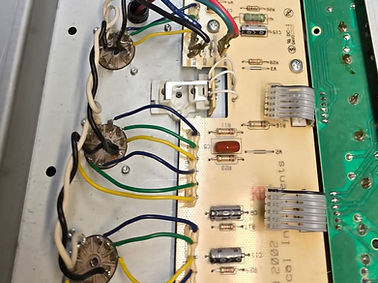
Channel Mixing
On the '68 model, Fender have linked the channels, so both have access to the reverb and vibrato. The way they have done it is simple, but problematic, and causes noise. The channels can be de-linked to reduce noise, (but then you lose the effects on the "Custom" channel) or with a bit more work (cutting some tracks, and installing extra mixing components and links), the job can be done properly. As long as you're not squeamish about cutting tracks
I'm not as I've done this a few times before. It's completely reversible, but why would you?

PS - We can carry out this improvement / mod to the hand-wired custom model too - now there's a noisy amp!
Vibrato Opto-coupler "Roach"
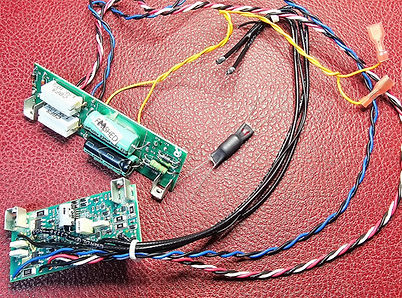
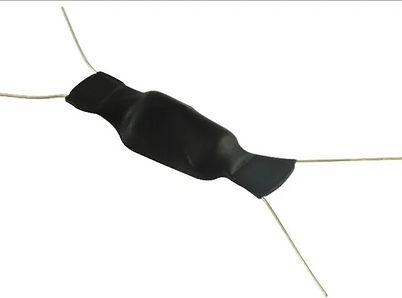
Many traditional Fender amps use a device called an opto-coupler, (sometimes called a "roach") to produce the vibrato effect. It's the black component in the middle of this picture, just under 2" long. The part of it call an LDR (Light-Dependant Resistor) contains Cadmium, which is banned in the EU under ROHS legislation . So amps sold in Europe have an opto-coupler emulation board instead, which consists of everything else in the top picture. Probably more components than the whole of the rest of the amp, and a whole load of wiring too. Unfortunately, whilst it's doing a fairly poor job of emulating an opto-coupler, it's also causing interference and noise. So we whip it all out and fit a proper opto-coupler Roach instead (just don't eat it). We also carry out the standard Fender service bulletin fix for "de-ticking" the vibrato - that makes a difference too.
Speaker Jack Plug
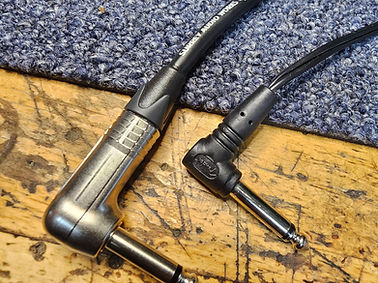
The stock moulded jack plug is a show-spoiler waiting to happen. These cheapy connectors have a rivetted tip connection (which you can't see because it's moulded) which vibrates loose and eventually fails altogether. We replace them with a genuine Neutrik angled plug, The bit you solder to is the same piece of metal which forms the tip of the connector, so there's nothing to vibrate loose.
Is It Worth It? Well, Yes It Is!
For many owners, absolutely. The Deluxe Reverb Reissue is already a very good amplifier, but a handful of cost-driven design compromises stop it from being as quiet as it could / should be. Carefully addressing those areas doesn't alter the amp's tone or feel, but it does remove unnecessary noise and helps the listener hear more of the smooth, articulate character, you'd associate with a "real" vintage Deluxe Reverb. Rather than changing the sound, the aim is to let more of the amp's true voice come through.